

Facial Ageing Explained: Why Lifts and Tightening Procedures Work

< Blog < Facial Ageing Explained: Why Lifts and Tightening Procedures Work
At Adnova, we regularly consult with patients concerned about sagging skin, deepening nasolabial folds, jowls, neck bands, and a general loss of facial definition. These changes are often described as “looking tired” or “older than I feel.” The good news is that modern facial rejuvenation surgery, particularly facelifts, neck lifts, and related tightening procedures, directly addresses the root causes of these visible signs.
Facial ageing is not simply “skin getting loose.” It is a multi-layered process involving bone, fat, muscle, ligaments, and skin. Understanding the science behind these changes explains why superficial treatments like creams or basic lasers fall short, and why surgical lifts and tightening procedures deliver natural, long-lasting results.
This article breaks down the mechanisms of facial ageing and shows exactly how facelift and tightening surgery counters them.
The Multi-Layered Anatomy of the Face
To understand ageing, picture the face as having five key layers, working from the inside out:
- Bone (craniofacial skeleton): the rigid foundation.
- Deep fat compartments: providing volume and support.
- Muscles and SMAS (Superficial Musculoaponeurotic System): the dynamic layer connecting muscle to skin.
- Superficial fat and retaining ligaments: anchoring and cushioning.
- Skin: the visible envelope.
Ageing affects every layer, often in sequence, creating a cascade of visible changes.

1. Bone Remodelling and Resorption
Recent studies (including 3D CT analyses up to 2025–2026) confirm that the facial skeleton undergoes progressive remodelling rather than simple uniform resorption. Key changes include:
- Orbital (eye socket) enlargement by 15-20% by the seventh decade, contributing to hollowed eyes and tear troughs.
- Midface retrusion (maxilla shortening by 8–15%), flattening cheeks.
- Mandibular angle widening (3–7°) and ridge resorption, leading to jowls and a less defined jawline.
- Overall, bone provides less structural support, allowing overlying tissues to descend under gravity.
This skeletal deflation is why simply adding volume (fillers) or tightening skin alone cannot fully restore youthful contours, the foundation has subtly shifted.
2. Fat Compartment Changes: Atrophy, Repositioning, and Volume Deflation
Facial fat is organised into distinct superficial and deep compartments, separated by ligaments. Ageing causes:
- Deep fat atrophy: especially in the midface and temples, leading to volume loss and hollowing.
- Superficial fat descent: compartments migrate downward due to ligament weakening and gravity, creating nasolabial folds, marionette lines, and jowls.
- Some areas (e.g., jowls) may see relative hypertrophy or redistribution rather than pure loss.
The result is “deflation”, cheeks flatten, under-eye hollows deepen, and the face loses its heart-shaped youthfulness, becoming more square or gaunt.
3. Muscle and SMAS Weakening
The SMAS is a continuous fibrous-muscular sheet extending from the neck (as platysma) to the forehead. With age:
- Muscle tone decreases.
- The platysma separates in the midline, forming vertical neck bands (“turkey neck”).
- Retaining ligaments stretch or attenuate, allowing SMAS and attached tissues to descend.
This creates midface ptosis (droop), jowls, and loose neck skin.
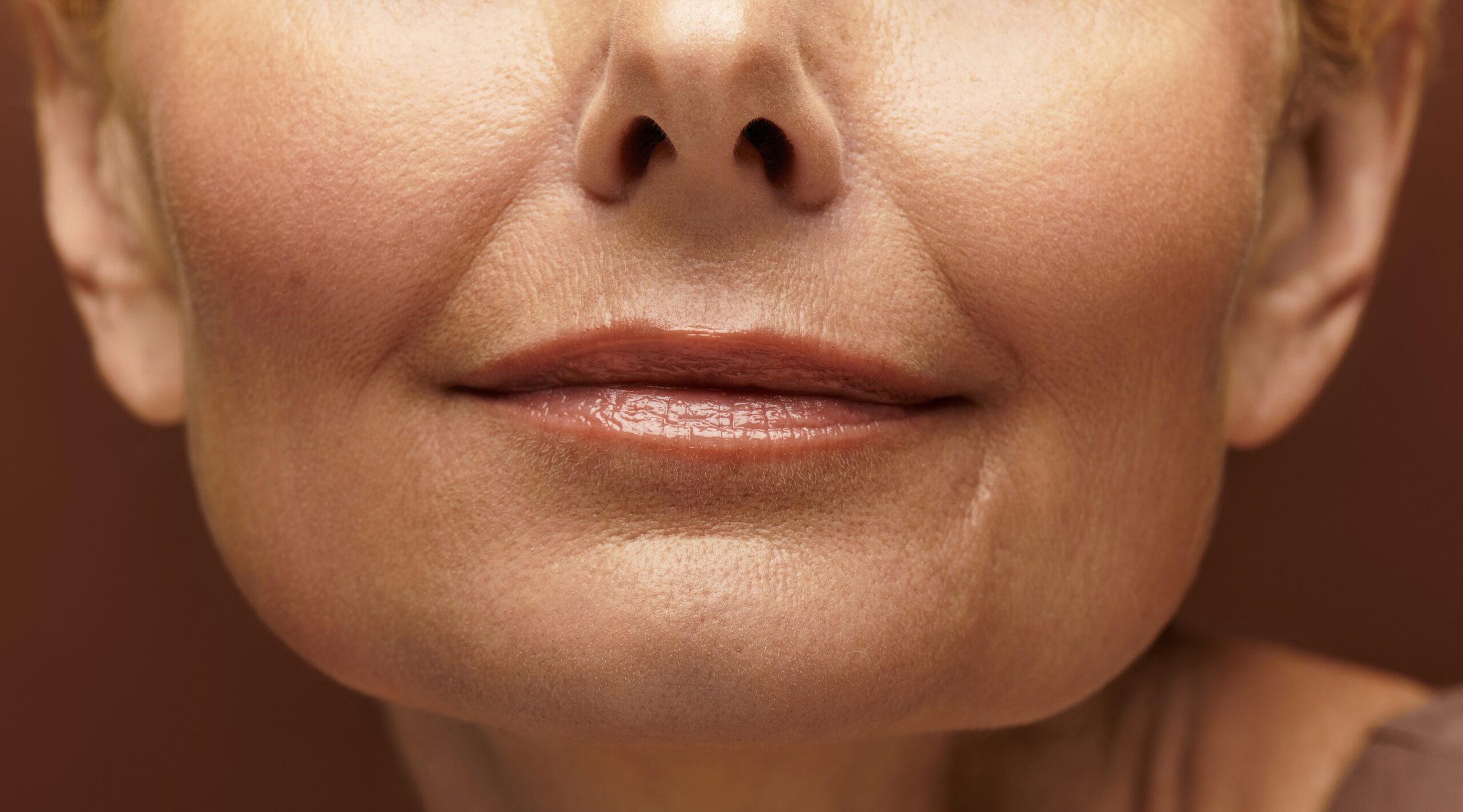
4. Skin Changes: Loss of Elasticity and Quality
Skin thins as collagen and elastin degrade (intrinsic ageing), compounded by extrinsic factors like UV exposure, which upregulates matrix metalloproteinases (MMPs) that break down ECM. The skin loses recoil, becoming lax and unable to “snap back” over repositioned deeper tissues.
Combined, these changes produce the classic signs: sagging, folds, bands, and texture issues.

Why Facelifts and Tightening Procedures Are So Effective
Surgical lifts target the deeper layers where ageing originates, unlike non-surgical options that mostly address surface skin.
Traditional vs. Modern Facelift Techniques
Early facelifts pulled only skin, results looked tight but unnatural with short longevity due to skin stretching.
Modern approaches focus on the SMAS and deeper planes:
- SMAS Facelift: The surgeon elevates, repositions, and secures the SMAS layer. This lifts cheeks, smooths nasolabial folds, defines the jawline, and reduces jowls without excessive skin tension. Tension is placed on strong fascia, not fragile skin, for more durable results.
- Deep Plane Facelift: An advanced evolution (popularised in the 1990s and refined since). Dissection occurs beneath the SMAS, releasing key retaining ligaments (e.g., zygomatic, mandibular) and mobilising muscle, fat, and SMAS as a single composite flap. This achieves:
- Greater midface lift.
- Natural volume restoration by repositioning descended fat pads.
- Superior jawline and neck definition.
- Tension-free skin closure, minimising scars and distortion.
Deep plane techniques produce longer-lasting outcomes (often 10–15+ years) because they correct the ptosis at its source, restoring the natural anatomy rather than fighting gravity with skin pull alone.
Neck Lift (Platysmaplasty)
Often combined with facelift, this specifically addresses the neck:
- The platysma is accessed via a small incision under the chin.
- Separated edges are sutured together (corset platysmaplasty), eliminating vertical bands.
- Excess fat is removed or contoured.
- Skin is redraped and tightened.
This restores a sharp cervicomental angle and smooth neck contour, countering muscle separation and skin laxity.

Why These Procedures Work So Well Scientifically
- They reposition descended tissues rather than just excise skin.
- By releasing ligaments, surgeons achieve extensive mobilisation without unnatural tension.
- Repositioning fat compartments restores volume where it belongs, cheeks regain projection, hollows fill naturally.
- SMAS/platysma tightening rebuilds structural support lost to ageing.
- Skin redraping becomes tension-free, improving scar quality and longevity.
Patients at Adnova Clinic who undergo extended SMAS techniques frequently report looking “refreshed” rather than “done,” with results that age gracefully.
Complementary Approaches at Adnova Clinic
While surgery resets the clock, maintenance such as the below maximises longevity:
- Volume restoration with hyaluronic acid fillers for fine-tuning (e.g., tear troughs, lips).
- Neuromodulators to prevent dynamic lines.
- Skin-quality treatments (Profhilo, microneedling, medical-grade skincare).
- Annual reviews to monitor and adjust non-surgically.
Facial ageing is a predictable, layered process: bone remodelling reduces support, fat deflates and descends, SMAS and muscles weaken, and skin loses elasticity. Lifts and tightening procedures — especially modern SMAS and deep plane techniques; work because they directly reverse these core mechanisms, repositioning tissues anatomically for natural, durable rejuvenation.
At Adnova Clinic, our philosophy is evidence-based surgery combined with personalised care. The Adnova surgeons use advanced techniques tailored to each patient’s anatomy and goals, ensuring results that look like you, only younger and more rested.
Disclaimer: The prices listed in this article are for general guidance only and may be subject to change. For the most up-to-date and accurate pricing, please visit our face pricelist, body pricelist and breast pricelist.